
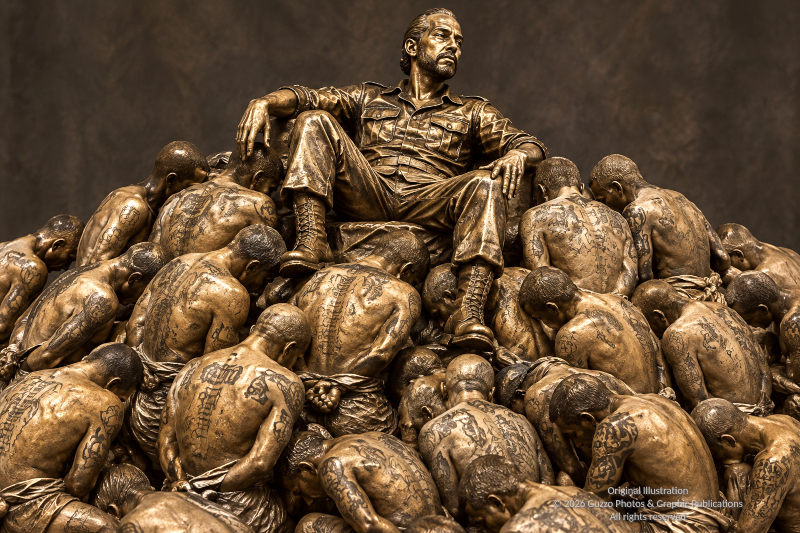
Haiti has endured years of tragedy while much of the international community has watched with a mixture of concern, helplessness and increasingly familiar indifference. Armed gangs contest territory, intimidate communities and challenge institutions already weakened by political instability. Ordinary Haitians are left paying the price for a conflict they never chose and a peace that nobody has yet managed to secure.
The disappearance of four Salvadoran military aviation technicians serving with an international security mission has introduced another dangerous complication. The men went missing following an ambush in gang-controlled territory near Port-au-Prince. Rescue operations have been launched, while El Salvador has announced plans for substantial military reinforcements. The scale of the intended deployment should not, however, be confused with the number of troops independently confirmed to have arrived. Nor has the fate of the missing personnel been conclusively established.
President Nayib Bukele has become central to the controversy. His administration’s uncompromising campaign against criminal gangs has dramatically reduced homicidal violence in El Salvador, but it has also attracted serious criticism concerning arbitrary detention, judicial safeguards and fundamental rights. To dismiss the security gains would be intellectually dishonest. To overlook the accompanying questions of justice would be equally irresponsible.
There is, moreover, a considerable difference between confronting organised crime within one’s own borders and conducting military operations on foreign soil. Haiti is not El Salvador, and policies cannot simply be exported like manufactured goods. International participation requires clear legal authority, operational accountability and respect for Haitian sovereignty. Those are not bureaucratic inconveniences. They are the foundations of legitimate intervention.
Since the assassination of President Jovenel Moïse in July 2021, Haiti’s political crisis has deepened, exposing the fragility of institutions already struggling to provide security and basic services. Criminal organisations have exploited the vacuum. Yet the problem is not merely a shortage of armed personnel. A country cannot be rebuilt through patrols alone, particularly when schools, courts, hospitals and economic opportunities remain beyond the reach of large sections of its population.
International security operations consequently face a challenge far greater than occupying a street or dispersing an armed group. They require intelligence, coordination, resources and, above all, Haitian institutions capable of maintaining whatever gains are achieved. An armoured vehicle may clear a road. It cannot, by itself, restore public confidence. And no amount of military hardware has yet been designed to manufacture democratic legitimacy.
Haiti’s long history of foreign intervention should also encourage caution. Too many missions have arrived bearing ambitious promises and departed leaving fundamental problems unresolved. Any expanded military engagement must therefore have clearly defined objectives, transparent command arrangements and effective safeguards for civilians. International solidarity should strengthen Haiti’s capacity to govern itself, not condemn it to permanent dependence on foreign forces.
Should the Salvadoran operation expand as announced, several questions will demand answers. Who commands the additional troops? Under what authority will they operate? How long will they remain? What measures will protect civilians, and who will be accountable for mistakes? Asking these questions does not weaken the fight against organised crime. It distinguishes a lawful security operation from an improvised display of power.
Haitians have every right to demand protection from kidnapping, extortion and murder. But lasting security also requires functioning courts, responsible government, public services and economic opportunity. Without those foundations, an armed organisation may lose a neighbourhood today only to reappear tomorrow under another name, another leader or another banner.
Here lies the uncomfortable paradox of international diplomacy: the world demands stability in Haiti while repeatedly searching for quick solutions to problems accumulated over generations. Gangs may exercise power through fear. States, however, are obliged to govern through law. If the international community wishes to demonstrate that it still understands the distinction, it must offer Haiti considerably more than military photographs, threats and carefully polished communiqués.
© 🖋️ By The Observer of the Global Order | 2026 — All Rights Reserved
Also available in other languages:
🇮🇹 Italiano
–
🇬🇧 English
–
🇦🇷Spanish
–
🇭🇰 中文(繁體)
–
🌍 عربي
–
🇫🇷 Français
–
🇧🇷 Portugués
–
© 2026 SalaStampa.eu, world press service – All Rights Reserved – Guzzo Photos & Graphic Publications – Registro Editori e Stampatori n. 1441 Turin, Italy
Sources consulted: Reuters, Associated Press and BBC News, October 2026.
Editorial note: This is an independent opinion piece. The precise scale of the Salvadoran deployment and the fate of the missing personnel remain subject to further verification.